Monday, January 2, 2012

Sunday, September 25, 2011
Foreign Military Sale to Pakistan
Pakistan – F-16C/D Block 50/52 Aircraft
On 28 June 2006, the Defense Security Cooperation Agency notified Congress of a possible Foreign Military Sale to Pakistan of 36 F-16C/D Block 50/52 Aircraft as well as associated equipment and services. The total value, if all options are exercised, could be as high as $3 billion.
The Government of Pakistan has requested a possible sale of:
Major Defense Equipment (MDE)
36 F-16C/D Block 50/52 aircraft with either the F100-PW-229 or F110-GE-129 Increased Performance Engines (IPEs) and APG-68(V)9 radars;
7 spare F100-PW-229 IPE or F110-GE-129 IPE engines;
7 spare APG-68(V)9 radar sets;
36 Joint Helmet Mounted Cueing Systems;
36 AN/ARC-238 SINCGARS radios with HAVE QUICK I/II;
36 Conformal Fuel Tanks (pairs);
36 Link-16 Multifunctional Information Distribution System-Low Volume Terminals;
36 Global Positioning Systems (GPS) and Embedded GPS/Inertial Navigation Systems;
36 APX-113 Advanced Identification Friend or Foe Systems;
36 Advanced Integrated Defensive Electronic Warfare Suites without Digital Radio
Frequency Memory (DRFM) or AN/ALQ-184 Electronic Counter Measures pod without DRFM or AN/ALQ-131 Electronic Counter Measures pod without DRFM or AN/ALQ-187 Advanced Self-Protection Integrated Suites without DRFM; or AN/ALQ-178 Self-Protection Electronic Warfare Suites without DRFM and
1 Unit Level Trainer;
Associated support equipment, software development/integration, modification kits, capability to employ a wide variety of munitions, spares and repair parts, flight test instrumentation, publications and technical documentation, CONUS-personnel training and training equipment, U.S. Government and contractor technical and logistics personnel services, and other related requirements to ensure full program supportability will also be provided. The estimated cost is $3 billion.
Given its geo-strategic location and partnership in the Global War on Terrorism (GWOT), Pakistan is a vital ally of the United States, as reflected in the June 2004 designation of Pakistan as a Major Non-North Atlantic Treaty Organization Ally. This proposed sale will contribute to the foreign policy and national security of the United States by helping an ally meet its legitimate defense requirements. The aircraft also will be used for close air support in ongoing operations contributing to the GWOT.
Consistent with U.S. conventional arms transfer policy and arms control initiatives, this potential sale will allow the Pakistani Air Force to modernize its aging fighter inventory, thereby enabling Pakistan to support both its own air defense needs and coalition operations.
Release of this system would not significantly reduce India's quantitative or qualitative military advantage. Release of the F-16C/D Block 50/52 aircraft to Pakistan will neither affect the regional balance of power nor introduce a new technology as this level of capability or higher already exists in other countries in the region.
The principal contractors will be:
BAE Advanced Systems Greenlawn, New York
Boeing Corporation Seattle, Washington
Boeing Integrated Defense Systems St Louis, Missouri
(three locations) Long Beach, California
San Diego, California
Raytheon Company Lexington, Massachusetts
(two locations) Goleta, California
Raytheon Missile Systems Tucson, Arizona
Lockheed Martin Aeronautics Company Fort Worth, Texas
Lockheed Martin Missile and Fire Control Dallas, Texas
Northrop-Grumman Electro-Optical Systems Garland, Texas
Northrop-Grumman Electronic Systems Baltimore, Maryland
Pratt & Whitney United Technology Company East Hartford, Connecticut
General Electric Aircraft Engines Cincinnati, Ohio
There are no known offset agreements in connection with this proposed sale.
http://timemilitary.files.wordpress.com/2011/09/pakistan_06-09.pdf
On 28 June 2006, the Defense Security Cooperation Agency notified Congress of a possible Foreign Military Sale to Pakistan of 36 F-16C/D Block 50/52 Aircraft as well as associated equipment and services. The total value, if all options are exercised, could be as high as $3 billion.
The Government of Pakistan has requested a possible sale of:
Major Defense Equipment (MDE)
36 F-16C/D Block 50/52 aircraft with either the F100-PW-229 or F110-GE-129 Increased Performance Engines (IPEs) and APG-68(V)9 radars;
7 spare F100-PW-229 IPE or F110-GE-129 IPE engines;
7 spare APG-68(V)9 radar sets;
36 Joint Helmet Mounted Cueing Systems;
36 AN/ARC-238 SINCGARS radios with HAVE QUICK I/II;
36 Conformal Fuel Tanks (pairs);
36 Link-16 Multifunctional Information Distribution System-Low Volume Terminals;
36 Global Positioning Systems (GPS) and Embedded GPS/Inertial Navigation Systems;
36 APX-113 Advanced Identification Friend or Foe Systems;
36 Advanced Integrated Defensive Electronic Warfare Suites without Digital Radio
Frequency Memory (DRFM) or AN/ALQ-184 Electronic Counter Measures pod without DRFM or AN/ALQ-131 Electronic Counter Measures pod without DRFM or AN/ALQ-187 Advanced Self-Protection Integrated Suites without DRFM; or AN/ALQ-178 Self-Protection Electronic Warfare Suites without DRFM and
1 Unit Level Trainer;
Associated support equipment, software development/integration, modification kits, capability to employ a wide variety of munitions, spares and repair parts, flight test instrumentation, publications and technical documentation, CONUS-personnel training and training equipment, U.S. Government and contractor technical and logistics personnel services, and other related requirements to ensure full program supportability will also be provided. The estimated cost is $3 billion.
Given its geo-strategic location and partnership in the Global War on Terrorism (GWOT), Pakistan is a vital ally of the United States, as reflected in the June 2004 designation of Pakistan as a Major Non-North Atlantic Treaty Organization Ally. This proposed sale will contribute to the foreign policy and national security of the United States by helping an ally meet its legitimate defense requirements. The aircraft also will be used for close air support in ongoing operations contributing to the GWOT.
Consistent with U.S. conventional arms transfer policy and arms control initiatives, this potential sale will allow the Pakistani Air Force to modernize its aging fighter inventory, thereby enabling Pakistan to support both its own air defense needs and coalition operations.
Release of this system would not significantly reduce India's quantitative or qualitative military advantage. Release of the F-16C/D Block 50/52 aircraft to Pakistan will neither affect the regional balance of power nor introduce a new technology as this level of capability or higher already exists in other countries in the region.
The principal contractors will be:
BAE Advanced Systems Greenlawn, New York
Boeing Corporation Seattle, Washington
Boeing Integrated Defense Systems St Louis, Missouri
(three locations) Long Beach, California
San Diego, California
Raytheon Company Lexington, Massachusetts
(two locations) Goleta, California
Raytheon Missile Systems Tucson, Arizona
Lockheed Martin Aeronautics Company Fort Worth, Texas
Lockheed Martin Missile and Fire Control Dallas, Texas
Northrop-Grumman Electro-Optical Systems Garland, Texas
Northrop-Grumman Electronic Systems Baltimore, Maryland
Pratt & Whitney United Technology Company East Hartford, Connecticut
General Electric Aircraft Engines Cincinnati, Ohio
There are no known offset agreements in connection with this proposed sale.
http://timemilitary.files.wordpress.com/2011/09/pakistan_06-09.pdf
Tuesday, July 20, 2010
SLAR Side Looking Radar


Side Looking Airborne Radar (SLAR)
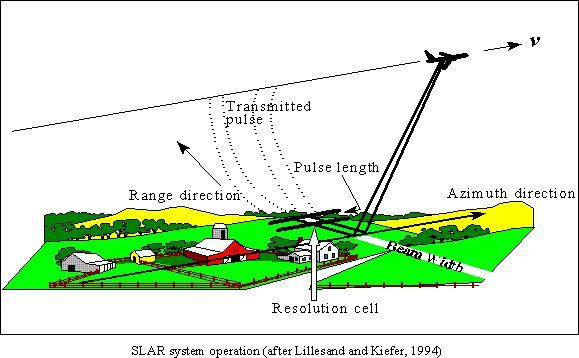
Figure 1: Side-looking viewing geometry of imaging radar system.
Side Looking Airborne Radar (SLAR)
 Figure 1: Side-looking viewing geometry of imaging radar system.
Swath width refers to the strip of the Earth’s surface from which data are collected by a side-looking airborne radar. It is the width of the imaged scene in the range dimension. The longitudinal extent of the swath is defined by the motion of the aircraft with respect to the surface, whereas the swath width is measured perpendicularly to the longitudinal extent of the swath.
The SLAR is a real aperture radar primarily. This requires a reasonable large antenna for adequately angular resolution. The azimuth resolution, Ra, is defined as
| Ra = | H · λ | H is the height of the antenna, (height of the airplane) L is the geometric length of the antenna, λ is the wavelength of the transmitted pulses, and θ is the incidence angle | (1) |
| L · cos θ |
 Figure 2: Resolution cell variation.
 Figure 2: Resolution cell variation.
The equation shows, that with increasing altitude decreases the azimuthal resolution of SLAR. A very long antenna (i.e., large L) would be required to achieve a good resolution from a satellite. Synthetic Aperture Radar (SAR) is used to acquire higher resolution.
The size of the ground resolution cell increases on the side of the nadir as the distance between radar platform and the ground resolution cell increases. This means that the ground resolution cells are larger towards the edge of the image than near the middle. This causes a scale distortion, which must be accounted for.
At all ranges the radar antenna measures the radial line of sight distance between the radar and each target on the surface. This is the slant range distance. The ground range distance is the true horizontal distance along the ground corresponding to each point measured in slant range. The cross-track resolution, Rr, is defined as:
| Rr = | c0 · tp | c0 is the speed of light tp is the pulse duration of the transmitter, and θ = incidence angle | (2) |
| 2 sin θ |
For an SLAR with the following characteristics:
λ = 1 cm,
L = 3 m,
H = 6000 m,
θ = 60°, and
tp = 100 ns,
has got a resolution of
Ra = 40 m and
Rr = 17.3 m
λ = 1 cm,
L = 3 m,
H = 6000 m,
θ = 60°, and
tp = 100 ns,
has got a resolution of
Ra = 40 m and
Rr = 17.3 m
The platform (aircraft or satellite) of an side-looking airborne radar (SLAR) travels forward in the flight direction with the nadir directly beneath the platform. The microwave beam is transmitted obliquely at right angles to the direction of flight illuminating a swath. Range refers to the across-track dimension perpendicular to the flight direction, while azimuth refers to the along-track dimension parallel to the flight direction.
Side-Looking Airborne Radar (SLAR) is an aircraft- or satellite-mounted imaging radar pointing perpendicular to the direction of flight (hence “side-looking”). A squinted mode is possible also. SLAR can be fitted with a real aperture antenna (Real Aperture Radar, RAR) or an antenna using synthetic aperture (SAR).
The platform of the radar moves in direction of the x-axis. The radar “looks” with the looking angle θ (or so called off-nadir angle). The angle α between x-axis and the line of sight (LOS) is called cone angle, the angle φ between the x-axis and the projection of the line of sight to the (x; y)-plane is called azimuth angle. Cone- and azimuth angle are related by cosα = cosφ ∙ cosε. On the earth surface the wave comes in at the (nominal ellipsoidal) incident angle β with respect to the vertical axis at this point. (In some publications the incident angle is denominated to as θi.) The antenna illuminates an area, the so called footprint. The direction of the incoming wave relative to the horizontal plane may be measured also. This angle γ = 90° − β is called grazing angle. The angle ϑ = ε + 90° is used for a mathematical description in a spherical coordinate system.
For the approximation of a flat earth – which is usual for airborne radar with short to medium range – the grazing angle and the depression angle can be assumed to be equal γ = ε and the incident angle is β = 180° – ϑ. The so called LOS-vector is a unit vector
 (in the figures shown as a red arrow) pointing from the antenna to a ground scatterer. The variables u, v, w are directional cosines with respect to the x; y; z axes. The variable u is u = cosα with α as the azimuth angle between the line of sight and the x-axis (direction of flight).
.png)

Range resolution (across track)The range resolution (the ability to separate the pixels of the image perpendicular to the direction of flight) of an SLAR depends on the length of the transmitted pulse. At the ground of Earth the range resolution has got an inverse relationship with the depression angle:
 is typically 0.4 … 1 µs, i.e.
  = 8 … 200 m. The shorter the pulse width the lower and the higher the range resolution, but the lower the echo signal. This limitation can be overcome using intra-pulse modulation. Using a step-frequency waveform of bandwidth B the range resolution is
  .
.


-
= speed of light
= depression angle
is typically 0.4 … 1 µs, i.e. = 8 … 200 m. The shorter the pulse width the lower and the higher the range resolution, but the lower the echo signal. This limitation can be overcome using intra-pulse modulation. Using a step-frequency waveform of bandwidth B the range resolution is .Azimuthal resolution (along track)
The azimuthal resolution (better known to as crossrange resolution) depends on the beamwidth of the radar antenna. It is derived from the ratio of the physical size of the antenna (the real aperture) to the wavelength used. By the spreading of the beam it is also dependent on the slant range.
-
= wavelength
= antenna length (in direction of flight)
= slant range
= height of the platform
http://www.radartutorial.eu/20.airborne/ab06.en.html
http://www.geo.hunter.cuny.edu/terrain/radarii.html
http://www.geo.hunter.cuny.edu/terrain/radarii.html
History of Radar
The history of radar starts with experiments by Heinrich Hertz in the late 19th century that showed that radio waves were reflected by metallic objects. This possibility was suggested in James Clerk Maxwell's seminal work on electromagnetism. However, it was not until the early 20th century that systems able to use these principles were becoming widely available, and it was German engineer Christian Huelsmeyer who first used them to build simple ship detection device intended to help avoid collisions in fog.
http://en.wikipedia.org/wiki/History_of_radar
http://en.wikipedia.org/wiki/History_of_radar
Friday, February 5, 2010
Industry Search Alacrastore Number of Corporations
Industry Companies
Aerospace & Defense 197
Agricultural Chemicals 203
Agriculture 584
Airline 156
Alcoholic Beverages 119
Apparel & Accessories 589
Applications Software 756
Automotive 961
Baked Goods 72
Banking 2,404
Beer 83
Beverage 181
Biotechnology 301
Broadcasting & Cable TV 308
Building Products 967
Business Services 1,210
Candy 76
Chemical 583
Coal 143
Computer 628
Computer Networking 213
Computer Peripherals 358
Conglomerates and Holding Companies 1,611
Construction 1,387
Consumer Electronics 298
Dairy Products 107
Department Stores 116
DIY 39
Education & Training 132
Electronic Components 1,199
Energy 166
Entertainment 486
Fast Foods 89
Feed 42
Financial Services 1,694
Food 989
Footwear 117
Forest Products 274
Frozen Prepared Foods 32
Glass Packaging 41
Health Care 390
Home Furnishings 272
Household Appliances 174
Household Cleaners 40
Industrial Machinery 1,922
Information Industry 224
Inorganic Chemicals 263
Insurance 667
Mail Order 61
Industry Companies
Marine Transportation 466
Medical Devices & Diagnostics 689
Metal Packaging 46
Metals 1,527
Mining 2,811
Mobile Communications 158
Nonalcoholic Beverages 69
Office Equipment 155
Oil & Gas 1,782
Online Services 516
Organic Chemicals 237
Packaging 46
Paints & Varnishes 106
Paper & Paper Products 297
Paper Packaging 68
Personal Care Products 146
Personal Computers 9
Pharmaceutical 1,345
Photography 49
Pipeline Distribution 28
Plastic Packaging 114
Plastics 411
Portable Computers 25
Printing & Publishing 505
Professional & Management Services 1,237
Railways 91
Real Estate 1,801
Recording 34
Restaurants 232
Retailing Non-Food 756
Sanitary Paper Products 29
Securities 3,940
Semiconductors 552
Snack Foods 13
Software 851
Sporting Goods 101
Supermarkets 174
Telecom Equipment 487
Telecom Services 331
Telecommunications 307
Textiles 1,082
Tire & Rubber 98
Tobacco 59
Tools & Instruments 233
Toys & Games 102
Transportation 373
Travel & Leisure 769
Trucking & Courier Services 131
Utilities 844
Waste Management 203
Datamonitor, Forrester, Moody's, and S&P.
http://www.alacrastore.com/search-by/industry
Aerospace & Defense 197
Agricultural Chemicals 203
Agriculture 584
Airline 156
Alcoholic Beverages 119
Apparel & Accessories 589
Applications Software 756
Automotive 961
Baked Goods 72
Banking 2,404
Beer 83
Beverage 181
Biotechnology 301
Broadcasting & Cable TV 308
Building Products 967
Business Services 1,210
Candy 76
Chemical 583
Coal 143
Computer 628
Computer Networking 213
Computer Peripherals 358
Conglomerates and Holding Companies 1,611
Construction 1,387
Consumer Electronics 298
Dairy Products 107
Department Stores 116
DIY 39
Education & Training 132
Electronic Components 1,199
Energy 166
Entertainment 486
Fast Foods 89
Feed 42
Financial Services 1,694
Food 989
Footwear 117
Forest Products 274
Frozen Prepared Foods 32
Glass Packaging 41
Health Care 390
Home Furnishings 272
Household Appliances 174
Household Cleaners 40
Industrial Machinery 1,922
Information Industry 224
Inorganic Chemicals 263
Insurance 667
Mail Order 61
Industry Companies
Marine Transportation 466
Medical Devices & Diagnostics 689
Metal Packaging 46
Metals 1,527
Mining 2,811
Mobile Communications 158
Nonalcoholic Beverages 69
Office Equipment 155
Oil & Gas 1,782
Online Services 516
Organic Chemicals 237
Packaging 46
Paints & Varnishes 106
Paper & Paper Products 297
Paper Packaging 68
Personal Care Products 146
Personal Computers 9
Pharmaceutical 1,345
Photography 49
Pipeline Distribution 28
Plastic Packaging 114
Plastics 411
Portable Computers 25
Printing & Publishing 505
Professional & Management Services 1,237
Railways 91
Real Estate 1,801
Recording 34
Restaurants 232
Retailing Non-Food 756
Sanitary Paper Products 29
Securities 3,940
Semiconductors 552
Snack Foods 13
Software 851
Sporting Goods 101
Supermarkets 174
Telecom Equipment 487
Telecom Services 331
Telecommunications 307
Textiles 1,082
Tire & Rubber 98
Tobacco 59
Tools & Instruments 233
Toys & Games 102
Transportation 373
Travel & Leisure 769
Trucking & Courier Services 131
Utilities 844
Waste Management 203
Datamonitor, Forrester, Moody's, and S&P.
http://www.alacrastore.com/search-by/industry
Monday, August 10, 2009

Dow Transport Components August-10-09
The Dow Jones Transportation Average [.DJT 3710.97 -38.61 (-1.03%) ] strongly outperformed the other major indices on Friday, rising 4 percent on broad strength from truckers YRC Worldwide (YRCW) and Ryder (R), railroads CSX (CSX) and Norfolk Southern (NSC), and airlines AMR (AMR) and Continental Airlines (CAL).
Take a look at how the 20 components of the Dow Transports have performed since March 9:
Con-Way (CNW) +258%
AMR (AMR) +117%
CSX (CSX) +112%
Ryder (R) +101%
GATX (GMT) +101%
FedEx (FDX) +98%
Continental Airlines (CAL) +92%
Union Pacific (UNP) +83%
Alexander & Baldwin (ALEX) +78%
Southwest Airlines (LUV) +76%
Norfolk Southern (NSC) +72%
JetBlue Airways (JBLU) +72%
Overseas Shipholding (OSG) +70%
Burlington Northern (BNI) +64%
JB Hunt (JBHT) +62%
CH Robinson Worldwide (CHRW) +44%
United Parcel Service (UPS) +41%
Expeditors International (EXPD) +37%
Landstar (LSTR) +36%
YRC Worldwide (YRCW) +27%
Take a look at how the 20 components of the Dow Transports have performed since March 9:
Con-Way (CNW) +258%
AMR (AMR) +117%
CSX (CSX) +112%
Ryder (R) +101%
GATX (GMT) +101%
FedEx (FDX) +98%
Continental Airlines (CAL) +92%
Union Pacific (UNP) +83%
Alexander & Baldwin (ALEX) +78%
Southwest Airlines (LUV) +76%
Norfolk Southern (NSC) +72%
JetBlue Airways (JBLU) +72%
Overseas Shipholding (OSG) +70%
Burlington Northern (BNI) +64%
JB Hunt (JBHT) +62%
CH Robinson Worldwide (CHRW) +44%
United Parcel Service (UPS) +41%
Expeditors International (EXPD) +37%
Landstar (LSTR) +36%
YRC Worldwide (YRCW) +27%
Subscribe to:
Posts (Atom)